
Last Updated: October 26, 2026
Quick Summary
To find a reliable local locksmith, verify licensing and registration, confirm bonding and liability insurance, check for a real physical storefront, and ask for a total price before work begins. A vetted local locksmith can name their issuing authority, show a certificate of insurance, and provide an itemized invoice that matches the estimate.
- Save the name, address, and license number of one verified locksmith in your phone before an emergency.
- Ask for a total price including the service call fee before any work starts.
- A realistic emergency response window is 15 to 45 minutes for a genuinely local provider.
- Confirm the street address on a map and in street view to rule out mailbox or virtual offices.
- After service, test the lock, check the strike plate, and confirm you received the correct number of keys.
Table of Contents
- Why Finding a Reliable Local Locksmith Matters
- How to Verify a Locksmith Before You Hire
- Questions to Ask a Locksmith Before Hiring
- Locksmith Scam Warning Signs to Watch For
- What Emergency Locksmith Response Time Should You Expect?
- Understanding Pricing, Estimates, and Hidden Fees
- The Post-Service Security Audit: A Step Most Homeowners Skip
- Book a Verified Local Locksmith for Your Next Lockout
- Frequently Asked Questions
Why Finding a Reliable Local Locksmith Matters
A lockout rarely happens at a convenient moment, a parking garage at night, a toddler waiting on the front step, a moving truck idling in the driveway.
At Natick Finest Locksmith, we have watched this play out for years across the Greater Boston area: panicked homeowners search, click the first sponsored result, and pay for a job quoted one way and billed another.
A reliable local locksmith is a licensed, insured, locally based professional who can verify their identity, provide a written estimate before work begins, and stand behind the result.
How to Verify a Locksmith Before You Hire
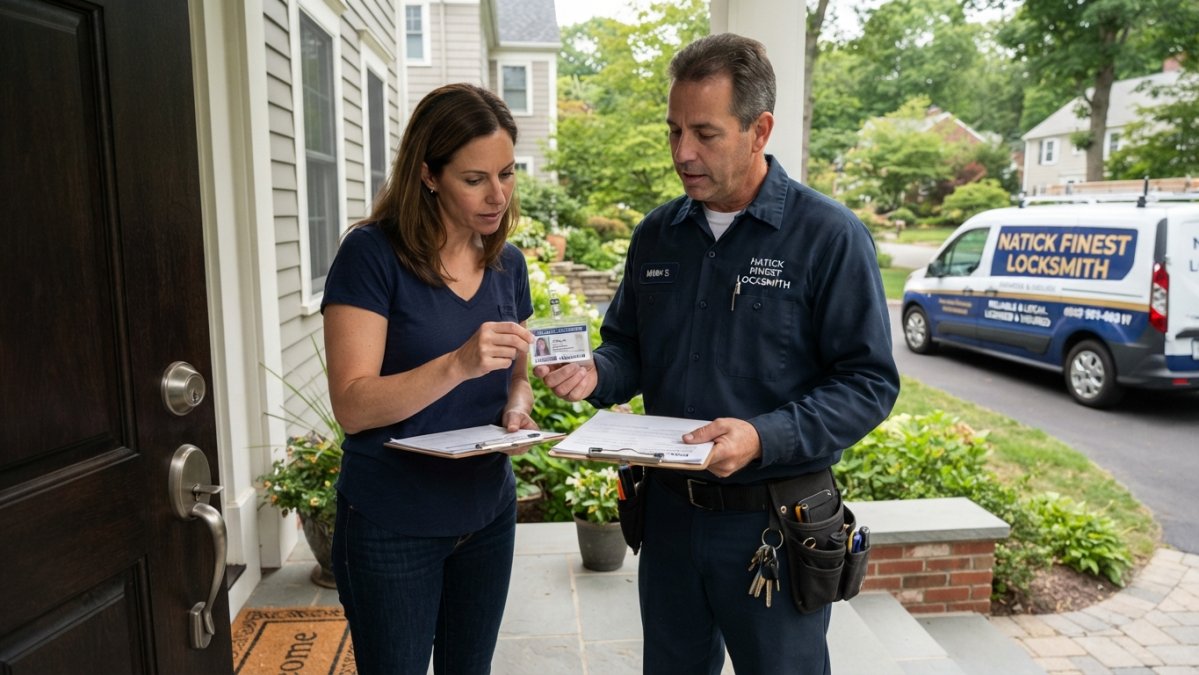
Verification is a short sequence you can run in under ten minutes before you let anyone touch your door. Confirm four things: the business is registered where it claims to be, it carries the right financial protections, its address is real, and the person at your door is the person the company sent. A legitimate local locksmith will walk through all four without friction; one that deflects or rushes is telling you something important.
Check Licensing and Registration at the Source
There is no single national locksmith license, so rules depend on your state and sometimes your city or county. Some require a state-issued locksmith license or registration; others require a local business license and permit; a few have no locksmith-specific requirement.
Ask for the license or registration number and the issuing authority, then verify it independently rather than trusting a photo of a card, most state licensing boards and many city business-license portals publish a searchable lookup. For a step-by-step walkthrough, see our guide on how to verify locksmith professional credentials.
Understand Bonding Versus Insurance
These two protections are often lumped together, but they do different jobs.
- Bonding is a surety arrangement. If the technician damages your property, fails to complete the job, or takes something from your home, the bond is a pool of money you can claim against. It does not automatically pay you; you generally have to file a claim with the surety, and the locksmith is on the hook to repay it. A bond is a signal of accountability more than a blanket payout.
- Liability insurance covers damage the business causes to your property or injury to someone on your premises during the job. This is the coverage that matters most for residential work, because a botched deadbolt installation that cracks a door frame or a technician who trips on your steps is a liability claim, not a bonding claim.
- Workers’ compensation insurance covers the technician if they are injured on your property. Without it, an injured worker could look to you for medical costs.
Ask for a certificate of insurance and read the coverage types, not just the expiration date. A bonded and insured business will not treat that request as an insult; it will usually have the certificate ready to email. If a company can only produce a bond and no liability coverage, ask who pays if your door frame is damaged.
Confirm a Physical Storefront, Not Just a Call Center
Many of the numbers that rank highest in search results belong to lead-generation call centers that dispatch whichever subcontractor is closest, and some use virtual office suites or mailbox storefronts to look local.
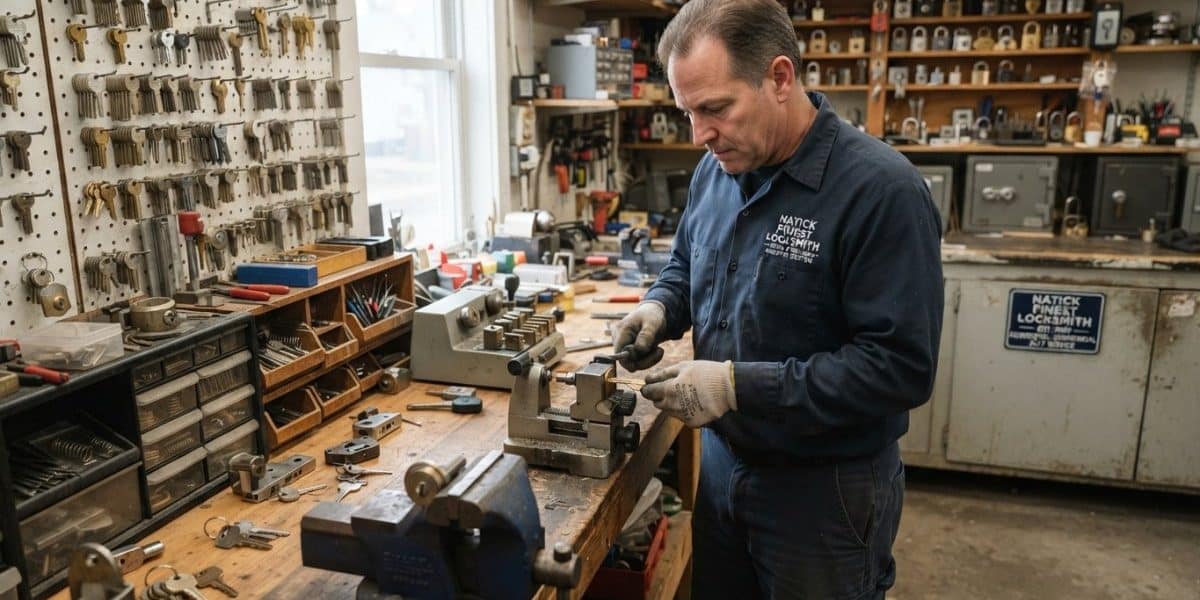
Open the address in a mapping tool’s street-view mode. A real locksmith shop usually shows a storefront, a sign, a service van, or a workshop entrance; an address that resolves to a residential mailbox, a shared virtual-office suite, or an empty lot is a warning.
Before you call, save the name, address, and license number of one verified local locksmith in your phone. In an actual lockout you will not have the patience to run these checks, and scammers count on that.
Verification comes down to confirming four things before anyone touches your door.
| What to confirm | How to check it | Why it matters |
|---|---|---|
| Licensing and registration | Ask for the number and issuing authority, then verify independently | Rules vary by state and city; no single national license |
| Bonding | Request the bond details and file with the surety if needed | A pool of money you can claim against, not an automatic payout |
| Liability insurance | Ask for a certificate of insurance and read coverage types | Covers damage to your property or injury during the job |
| Workers’ compensation | Confirm coverage before work begins | Without it, an injured technician could look to you |
| Physical storefront | Confirm the street address on a map and in street view | A mailbox or virtual office signals a lead-generation front |
| Technician identity | Ask for company ID and match the name to the business you called | An unmarked vehicle and no ID is a serious red flag |
Questions to Ask a Locksmith Before Hiring
The right questions separate a professional from a dispatcher. Ask them on the phone before anyone is sent, and listen for whether the answers are specific or rehearsed:
- What is your license or registration number, and who issues it?
- Can you give me a total price, including the service call fee, before you start?
- Are you the technician who will actually arrive, or a dispatcher?
- Do you carry ID, and will you show it before I unlock the door?
- What happens if the lock is damaged during the job?
- Will I receive an itemized invoice when the work is done?
A reputable service answers all six without friction. Vague answers about pricing or identity are the clearest signal to call someone else.
Locksmith Scam Warning Signs to Watch For
Scam prevention comes down to recognizing a handful of tactics that all rely on the same pressure: you are locked out, it is late, and you have few alternatives. Knowing the playbook in advance removes that leverage. These are the warning signs that show up most often.
The Bait-and-Switch Quote
The phone quote sounds reasonable, sometimes suspiciously low. Once the lock is being worked on, the price climbs, with new fees for “high-security” cylinders or emergency labor appearing after the fact. Estimate transparency is the antidote: insist on a total figure before work begins, ask what could change it, and get it in writing or by text. A business that refuses to commit to a figure is setting up the switch.
Lead-Generation Sites That Sell Your Call
A lead-generation site looks like a local locksmith directory or even a single company, but it employs no locksmiths. It collects your call or form submission and sells it to the highest bidder, often a subcontractor with no connection to the site you found.
The tells are in the details: the site lists many cities it “serves,” the number is toll-free rather than a local exchange, the address is a virtual office or mailbox store, and whoever answers cannot name the technician being dispatched or where they are coming from.
Unmarked Vehicles and No ID
A technician in an unmarked vehicle who offers no identification and cannot name the company that dispatched them is a serious red flag. Ask for the name on the work order and match it to the business you called. Identification verification takes ten seconds, and a legitimate technician expects the question and carries a company ID.
Pressure to Skip the Estimate or the Invoice
Scammers often push you to skip the written estimate, pay in cash only, or accept a verbal total. A real business will put the price in writing, accept a card or check, and give you an itemized invoice that matches the estimate. If the technician refuses to itemize or gets irritated when you ask, that is the signal to stop.
A Lock That Is “Damaged” and Must Be Replaced
A common pattern is the claim that your lock was damaged during service and must be replaced at a markup, even when it was working. Ask to see the damage before any replacement, and ask whether a rekeying service would solve the problem instead. A reputable technician shows you the part and explains the options rather than announcing a replacement after the fact.
If any of these signs appear after the technician is already at your door, you can still stop the job. You are not obligated to let someone work on your property, and you can ask them to leave and call a verified provider instead.
What Emergency Locksmith Response Time Should You Expect?
A realistic emergency response window is 15 to 45 minutes for a genuinely local provider, depending on traffic and time of day. Any business promising a fixed arrival time before it knows your location is guessing.
The emergency lockout call is where response-time promises get tested. Ask two direct questions: where is the technician coming from right now, and what is the realistic window? For a fuller breakdown, read our guide to emergency lockout response time expectations.
Understanding Pricing, Estimates, and Hidden Fees
Pricing depends on the lock type, the time of day, and the complexity of the job, so no honest provider quotes a flat number for every situation.
Hidden fees usually appear in three places: after-hours surcharges that were never mentioned, hardware markups added at the door, and charges for a lock that was “damaged” during service. Ask for an itemized invoice and compare it to the estimate you were given. For a detailed guide to spotting and avoiding these charges before you agree to anything, read avoiding hidden locksmith service fees.
The Post-Service Security Audit: A Step Most Homeowners Skip
Most people pay the invoice and never think about the lock again. That is a mistake. Once the technician leaves, spend two minutes confirming the work holds: test the lock several times, check that the key turns smoothly without force, verify the strike plate is seated flush, and confirm you were given the correct number of keys.
This step also catches a subtler problem. If a lock was picked rather than replaced during a lockout, the cylinder may still be vulnerable to the same technique.
Book a Verified Local Locksmith for Your Next Lockout
The challenge is simple: the locksmith industry rewards speed over verification, and scammers know it.
Natick Finest Locksmith is built around that standard. If you are ready to stop gambling on the first search result, book a verified local locksmith for your lockout, or review our residential locksmith services for home lock changes and security upgrades.
Get started with Natick Finest Locksmith and keep a verified, local team on call before you ever need one.
Frequently Asked Questions
How do I know if a locksmith is reputable?
Check for a physical storefront address, a state or local license, and proof of bonding and insurance. Ask for the technician’s name and ID before they start work. Look for recent customer testimonials that mention specific jobs, not generic praise. A reputable local locksmith will answer pricing questions upfront and provide an itemized invoice after the job. If a company only lists a toll-free number and cannot name a local address, treat that as a red flag.
What should I ask a locksmith before hiring them?
Ask for their license number and insurance coverage, whether they charge a service call fee, and how they calculate the final price. Confirm they will provide a written estimate before starting and an itemized invoice after. Ask how long they have served your area and whether they carry the right tools for your lock type. For emergencies, ask for a realistic arrival window and whether after-hours rates apply. Get the technician’s name and company name on the phone.
How can I avoid locksmith scams?
Watch for quotes that seem far below the local average, then balloon on arrival. Scam operators often use unmarked vehicles, refuse to show ID, and demand cash before finishing. Avoid companies that answer with a generic call center name and cannot confirm a physical address. Verify the business address on a map before booking. Ask for the total price in writing, including any service call fee, and never sign a blank work order. A legitimate local locksmith will not pressure you.
How quickly can an emergency locksmith arrive?
Response time depends on your location and the time of day. A local locksmith based in your service area can often arrive within 15 to 30 minutes for a standard lockout. During severe weather or peak hours, expect longer. When you call, ask for a specific arrival window, not a vague promise. Confirm whether the dispatcher is local or routing your call to a national network. A company that cannot give a realistic window is worth skipping.
What should I do if a locksmith gives me a much higher quote on arrival?
Do not agree to the higher price without asking for a written breakdown of the charges. If the technician refuses to provide an itemized estimate or pressures you to pay cash immediately, stop the work and ask them to leave. You can call another verified local locksmith. Report the incident to your state consumer protection office or the local police non-emergency line if you feel threatened. Keep any texts, quotes, or receipts as evidence.
Is $200 a lot for a locksmith?
Pricing varies by service, time of day, and lock type, so a single figure is not meaningful without context. Ask for a flat-rate quote before booking and confirm what the service call fee covers. The final invoice should itemize parts, labor, and any emergency surcharge. Compare at least two local quotes for the same job.
