
Table of Contents
- Commercial Lock Repair Same Day: How to Get It Done Right
- What Same-Day Service Actually Covers
- Step-by-Step Triage for a Broken Commercial Door Lock
- Commercial Door Lock Repair: What a Same-Day Visit Looks Like
- Commercial Lock Repair Time: How Long Each Job Takes
- Repair or Replace? Decision Criteria for Commercial Locks
- Commercial Lock Replacement Cost: What Drives the Final Number
- A Commercial Locksmith for Property Managers: Scheduling and Rekeying
- Conclusion: Get Your Locks Secured Today
- Frequently Asked Questions
Last Updated: October 5, 2026
Commercial Lock Repair Same Day: How to Get It Done Right
A jammed or broken commercial lock is a business emergency: every minute a storefront, office, or warehouse door stays unusable costs you staff access and customer traffic.
At Natick Finest Locksmith, we handle these calls daily across the Greater Boston area.
This guide covers what happens on a same-day commercial lock repair call: triage, the visit itself, job times, and when repair beats replacement.
What Same-Day Service Actually Covers
Same-day commercial lock repair covers diagnosis, repair or replacement of the hardware, and a working, secure door by the end of the visit, not a temporary patch.
A typical same-day call handles:
- Jammed or seized lock cylinders and latches
- Broken keys stuck in the lock body
- Failed panic bars, deadbolts, and exit devices
It usually does not cover full access control installation or door frame reconstruction, those are scheduled projects. If unsure, call and describe the symptom; quick phone triage often saves a wasted visit.
Step-by-Step Triage for a Broken Commercial Door Lock
Before you call, run this five-step triage. It tells you whether you have an emergency and gives the dispatcher details to send the right technician with the right parts.
- Test the key in every lock position. Does it turn at all, or only partway? A key that turns halfway points to a cylinder problem.
- Check the door itself. Does it close and latch cleanly when unlocked? If the door sticks or drags, the lock may be fine and the door is the issue.
- Listen and feel. Grinding, clicking, or a loose handle usually means worn internal components.
- Look for visible damage. Bent latches, loose screws, or a shifted strike plate are all repairable on site.
- Note the lock type. Deadbolt, mortise, cylindrical, panic bar, or electronic? This single detail speeds up dispatch.
Take a photo of the lock and door edge before you call. Sending it to the dispatcher lets the technician confirm the lock model and load the correct replacement cylinder before leaving the shop, which cuts your wait time.
Is It a Lock Problem or a Door Problem?
A lock that will not engage is not always broken.
Quick test: open the door and operate the lock by hand. If it moves freely open but jams closed, the door or frame needs adjustment.
That distinction changes the fix: alignment issues need hinge or strike plate adjustment, while a failed lock needs repair or replacement hardware.
Commercial Door Lock Repair: What a Same-Day Visit Looks Like
A same-day commercial door lock repair visit follows a predictable sequence: verification, diagnosis, repair, testing, and documentation. Knowing the steps helps you spot a technician who cuts corners.
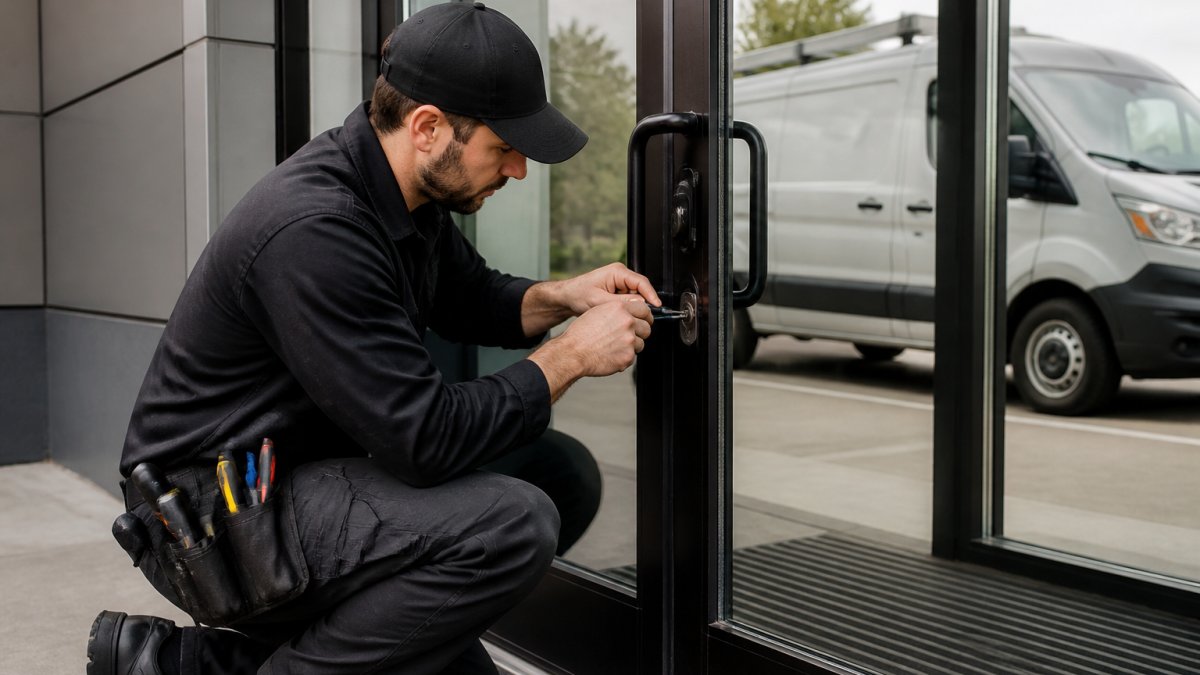
Here is what to expect:
- Arrival and ID check. The technician identifies themselves and confirms the work order with you.
- Diagnosis. They test the lock, inspect the door alignment, and explain the cause in plain terms.
- Quote before work. You get the repair options and the price before any work starts.
How to Verify a Locksmith Before You Authorize Work
Ask three questions before anyone touches the lock: Are you licensed and insured? What is the total price, including parts and labor? Will you provide a written invoice?
A legitimate commercial locksmith answers all three without hesitation.
Natick Finest Locksmith is an LLC and holds Yankee Security Certificates, so you can confirm who is at your door before work begins.
Commercial Lock Repair Time: How Long Each Job Takes
Most commercial lock repair jobs finish in 30 to 90 minutes once the technician is on site, depending on lock type and whether parts need replacing.
| Job Type | Typical On-Site Time | What It Involves |
|---|---|---|
| Stuck or jammed cylinder | 20-40 minutes | Lubrication, debris removal, or cylinder swap |
| Rekey existing lock | 15-30 minutes per cylinder | Pin change to match a new key |
| Deadbolt or latch replacement | 30-60 minutes | Remove old hardware, fit and align new unit |
| Panic bar or exit device repair | 45-90 minutes | Mechanism repair, alignment, function testing |
| Strike plate or door alignment fix | 20-45 minutes | Adjust hinges, reposition or replace strike plate |
The clock that matters most is dispatch time, not repair time. Most frustration businesses report comes from waiting hours for a technician. Ask about the expected arrival window when you call, and hold the dispatcher to it.
Repair or Replace? Decision Criteria for Commercial Locks
Most commercial lock calls come down to one question: can this hardware be brought back to reliable service, or is it time to replace it? Here is the framework technicians use.
The three-question test
Run every failed lock through three questions:
- Is the failure in a wear part or the lock body? Wear parts, cylinders, pins, springs, latches, strike plates, cam assemblies, are serviceable. A cracked or deformed lock body, a bent mortise case, or a housing that has been drilled or pried is not.
- Will a repair restore full function and security? A rekey after a lost key restores security. A patch on a lock that was defeated during a break-in does not.
- Does the repaired lock still meet the door’s code and rating requirements? Exit devices, fire-rated doors, and egress hardware carry specific performance requirements. If a repair cannot be documented as compliant, replace.
If all three answers point to repair, repair. If any one points to replace, replace.
Repair signals by lock type
- Cylindrical and mortise locks: Worn pins, a stiff or gritty cylinder, a lost key, or a misaligned latch are all repair work. A cracked cylinder housing or a case that has been forced is replacement.
- Panic bars and exit devices: Worn touchpad springs, misaligned latch bolts, and loose mounting are repairable. Bent crossbars, cracked end caps, or a device that has been defeated are not, and on an egress door, a compromised device is a life-safety issue, not a maintenance item.
- Electric strikes and access-control components: A failed solenoid, a misaligned strike, or a wiring fault is often repairable. A strike that has been physically forced or a reader that no longer communicates with the controller usually means replacement.
Cost crossover
A common pattern in the field: when the repair estimate approaches roughly half the cost of a comparable new commercial-grade unit, replacement is usually the better long-term call. It is not a hard rule, it depends on hardware age, parts availability, and door traffic, but it is a useful gut check.
Age and service history
- A lock that has been repaired twice in a twelve-month window is telling you something. The third call is usually the one that should have been a replacement.
- Hardware past its expected service life, heavy-traffic commercial locks commonly see 10 to 15 years before major components start failing, is a replacement candidate even if the current failure looks minor.
- If the manufacturer no longer supplies parts for the model, repair is a temporary fix at best.
After a break-in or forced entry
After forced entry, the default should be replacement, not repair. The lock was defeated once; a repaired version of the same hardware is a known target. This is also the moment to review key control, access logs if the door is electronic, and whether the hardware still meets egress and fire-door requirements. A qualified commercial locksmith should walk you through that review on the same visit.
Never authorize a repair on an exit door lock without confirming it still meets life safety code after the work. A lock that secures the door but blocks emergency egress is a serious liability, and it will fail inspection.
When to ask for a second opinion
If a technician recommends full replacement on a lock that is only a few years old with no physical damage, ask why. Legitimate reasons exist, discontinued parts, failed electronics, code changes, but ‘it’s old’ is not one. A written diagnosis naming the failed component is a reasonable request.
Commercial Lock Replacement Cost: What Drives the Final Number
Most commercial locksmith pages dodge pricing entirely, leaving property managers and business owners with no way to sanity-check a quote. Here is how commercial lock replacement cost is actually built, and what moves the number.
How a quote is assembled
A legitimate commercial lock replacement quote has four line items:
- Hardware. The lock or exit device itself, at the grade appropriate for the door.
- Labor. Removal of the old unit, fitting, alignment, and testing. Usually billed as a flat rate per door or an hourly rate with a stated minimum.
- Keying. Cutting new keys and pinning the cylinder to match an existing system or a new one.
- Service call and timing. A standard business-hours dispatch fee, or a higher after-hours and emergency rate.
If a quote does not break out at least hardware and labor, ask for a written breakdown before authorizing work.
What actually moves the number
- Lock type. A standard cylindrical or knob lock is the least expensive to replace. A mortise lock costs more because the case is larger, the installation is more involved, and the hardware itself is pricier. Panic bars and exit devices sit higher still because they carry life-safety ratings and must be installed and tested to code. Electronic access components, electric strikes, card readers, electromagnetic locks, are the most expensive category and often require low-voltage wiring work on top of the hardware.
- Hardware grade. Commercial-grade hardware built for heavy traffic costs more than residential-grade equivalents, and it lasts far longer. On a high-traffic storefront or a main building entrance, the cheaper unit is usually the more expensive decision over its service life.
- Number of doors. Multiple doors on one visit lower the per-door labor cost. A property manager replacing locks across a floor or a building should always ask for a multi-door rate.
Why no one can quote a flat rate over the phone
A phone quote without seeing the door is a guess. The dispatcher does not know the lock type, door material, frame condition, whether the cylinder can be reused, or whether the door is on a master key system.
A good dispatcher will instead ask for the lock type, a photo of the lock and door edge, and the door’s location and traffic level, enough to give a realistic range and send the right hardware on the van.
How to compare quotes fairly
When you have two or more quotes, compare them on the same four things:
- Hardware brand and grade, not just ‘commercial lock.’
- Labor scope, does it include door alignment and testing, or just the swap?
- Keying, how many keys, and are they matched to your existing system?
A lower number that excludes keying, alignment, or warranty is not actually lower.
Ask for the quote in writing before work starts, with hardware and labor broken out separately. A provider who will not put it in writing is telling you something.
What you should never see on an invoice
- A price that changed after the work started without your approval.
- A ‘diagnostic fee’ that was not disclosed on the phone.
- A full replacement billed when a repair was authorized.
For a transparent number, request a free estimate. We provide pricing before work starts so there are no surprises on the invoice.
A Commercial Locksmith for Property Managers: Scheduling and Rekeying
A commercial locksmith for property managers handles the recurring work that keeps a portfolio secure: rekeying units between tenants, master key systems, and scheduled maintenance across multiple doors.
For property managers, the practical approach is batch scheduling: group rekeys and lock repairs by building or date and use one visit to cover several units.
A few things to build into your routine:
- Rekey on every turnover. A new tenant should never inherit the previous tenant’s key.
- Maintain a master key system. One master key for staff, individual keys per unit, controlled access to restricted areas.
- Schedule preventive checks. Annual inspection of high-traffic doors catches alignment and wear problems before they become lockouts.
We work with landlords and property managers across the area on scheduled rekeying and same-day emergency calls, seven days a week.
Conclusion: Get Your Locks Secured Today
A failed commercial lock puts your property, staff, and operations at risk the moment it happens. The right response is a fast, verified technician who diagnoses the real cause, quotes before working, and leaves the door secure and code-compliant.
Natick Finest Locksmith provides immediate response, same-day service, and 24/7 availability with experienced technicians and code-compliant solutions.
Call Natick Finest Locksmith now to schedule a technician and get your doors secured today.
Frequently Asked Questions
How much does commercial lock replacement cost?
Commercial lock replacement cost depends on the lock type, door material, hardware grade, and whether access control components are involved. A standard cylindrical or mortise lock swap costs far less than replacing an electric strike or buzzer system. Because every commercial property is different, Natick Finest Locksmith provides a free estimate before any work begins. Call to schedule a same-day appointment and get a clear quote for your specific door.
Can a commercial locksmith repair a lock the same day?
Yes. Most commercial lock repair same day calls involve rekeying, cylinder replacement, or latch adjustment, all of which a mobile locksmith can complete in one visit. Natick Finest Locksmith carries common commercial hardware on every truck and offers 24/7 availability, so urgent lock repair does not have to wait until the next business day. Schedule a technician and confirm the parts needed when you call.
When should a commercial lock be repaired rather than replaced?
Repair makes sense when the lock mechanism is sound and the issue is wear, misalignment, or a worn cylinder. Replacement is the better call when the lock body is cracked, the door has been forced, or the hardware no longer meets your business security needs. A technician can assess the lock in minutes and explain both options with pricing before you decide. If a break-in occurred, replacement plus a security review is usually the safer path.
How long does commercial lock repair time usually run?
Most standard repairs, such as rekeying or cylinder swaps, take 30 to 60 minutes on site. Lock installation or full replacement can run one to two hours depending on the door and hardware. Access control work, like wiring an electric strike, may take longer. Natick Finest Locksmith dispatches technicians with the tools and parts needed to finish the job in a single visit whenever possible.