
Table of Contents
- How to Replace an Ignition Lock Cylinder: Step-by-Step
- Safety First: Disconnecting the Battery and Knowing When to Stop
- Ignition Lock Cylinder Replacement Tools You’ll Need
- Step 1: Remove Trim and Access the Cylinder
- Step 2: Release the Retaining Pin and Pull the Cylinder
- Ignition Cylinder Replacement Without Key: What Changes
- Step 3: Install, Rekey, and Test the New Cylinder
- Ignition Cylinder Replacement Time and Cost: What to Expect
- Frequently Asked Questions
Last Updated: October 13, 2026
How to Replace an Ignition Lock Cylinder: Step-by-Step
An ignition lock cylinder is the rotating barrel inside your steering column that accepts your key and controls the electrical contacts for accessory, run, and start. When it fails, you can’t start the car. We handle ignition lock cylinder replacement across the Greater Boston area.
The key insight most guides miss: the cylinder and the switch are two different parts. Replacing the wrong one wastes hours and money.
A few terms worth knowing before you start:
- Ignition lock cylinder: the keyed barrel you turn
- Ignition switch: the electrical component behind it
- Retaining pin: the small spring-loaded pin that locks the cylinder in place
Ignition Lock Cylinder vs. Ignition Switch: What You’re Actually Replacing
The ignition lock cylinder is the mechanical keyed barrel you insert your key into; the ignition switch is the electrical component behind it that sends power to the starter and ignition system.
The cylinder fails because of worn keyways, broken pins inside the barrel, or a stuck steering lock. The switch fails because of burned contacts or melted connectors. If your key turns smoothly but nothing happens, the switch is usually the culprit.
Symptoms That Point to a Failing Cylinder
A failing ignition lock cylinder shows clear symptoms: the key sticks or won’t turn past accessory, the steering wheel locks up even with the key inserted, you hear grinding when turning the key, or the key comes out while the car is running, a serious safety issue.
Here’s the diagnostic trick: try your spare key. If a worn key is the problem, the spare will work fine. According to NHTSA vehicle safety information, ignition and steering lock issues should be addressed promptly because they affect your ability to control the vehicle.
Safety First: Disconnecting the Battery and Knowing When to Stop
Disconnecting the negative battery terminal is the first step in any ignition lock cylinder replacement. It prevents accidental airbag deployment and shorts while you work near the steering column. Loosen the negative cable with a wrench and tuck it aside so it can’t touch the post.
When should you stop and call a professional? Here are the situations that call for it:
- Your vehicle has a transponder key or immobilizer system
- You don’t have the original key
- The steering column has airbag wiring you’re not sure about
Never work on the steering column with the battery connected. Airbag systems can deploy during removal and cause serious injury. If you’re unsure about any step near the airbag, stop and call a locksmith.
Ignition Lock Cylinder Replacement Tools You’ll Need
You don’t need a full shop, but you do need the right tools. Gather these before you start:
- Socket set with extensions
- Trim removal tools (plastic pry bars)
- Small pick or awl for the retaining pin
On a plastic ignition bezel, a trim tool saves you from cracking it. Prying trim with a flathead screwdriver leaves gouges visible every time you get in the car.
Step 1: Remove Trim and Access the Cylinder
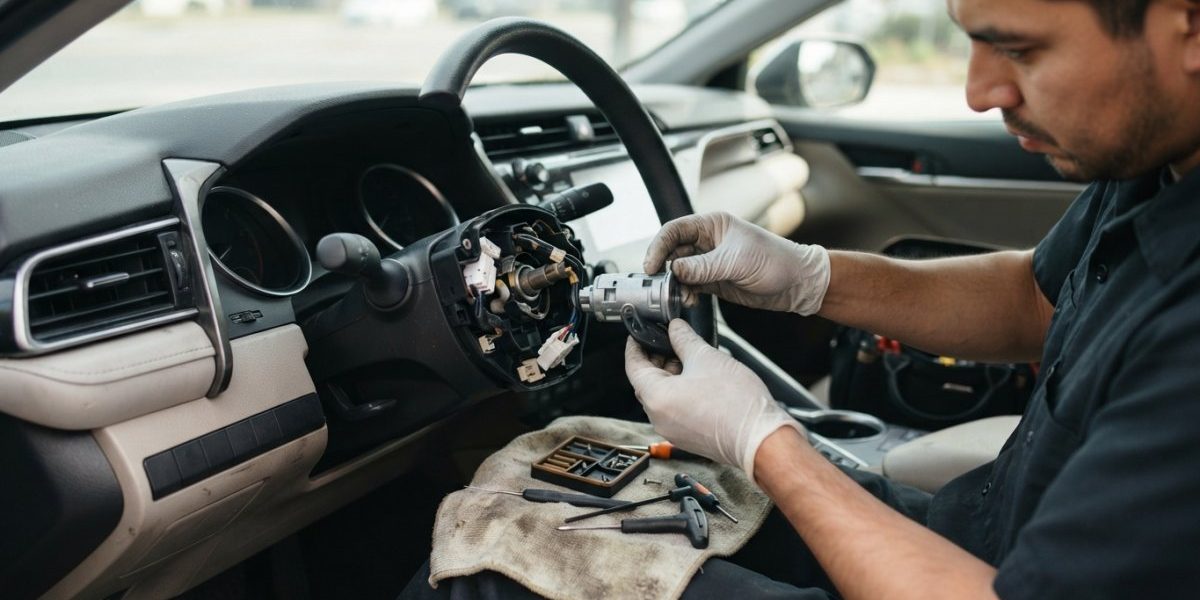
Removing the trim is where most DIY jobs stall. Take off the negative battery cable, then remove the steering-column cover or dashboard bezel around the ignition. On most vehicles, the lower dash panel and plastic ignition bezel pop off with trim tools after a few screws.
Here’s the sequence:
- Disconnect the negative battery terminal
- Remove the lower dash panel screws
- Pop the plastic ignition bezel free with a trim tool
- Remove the steering-column cover screws
- Set the trim pieces aside where they won’t get scratched
Expect repair guidance from the National Institute for Automotive Service Excellence to emphasize using the right trim tools. Forcing plastic clips breaks them, and replacements cost more than the tools.
Step 2: Release the Retaining Pin and Pull the Cylinder
With the trim off, insert the original key and turn it to the accessory or run position. This exposes the retaining pin hole on the lock housing.
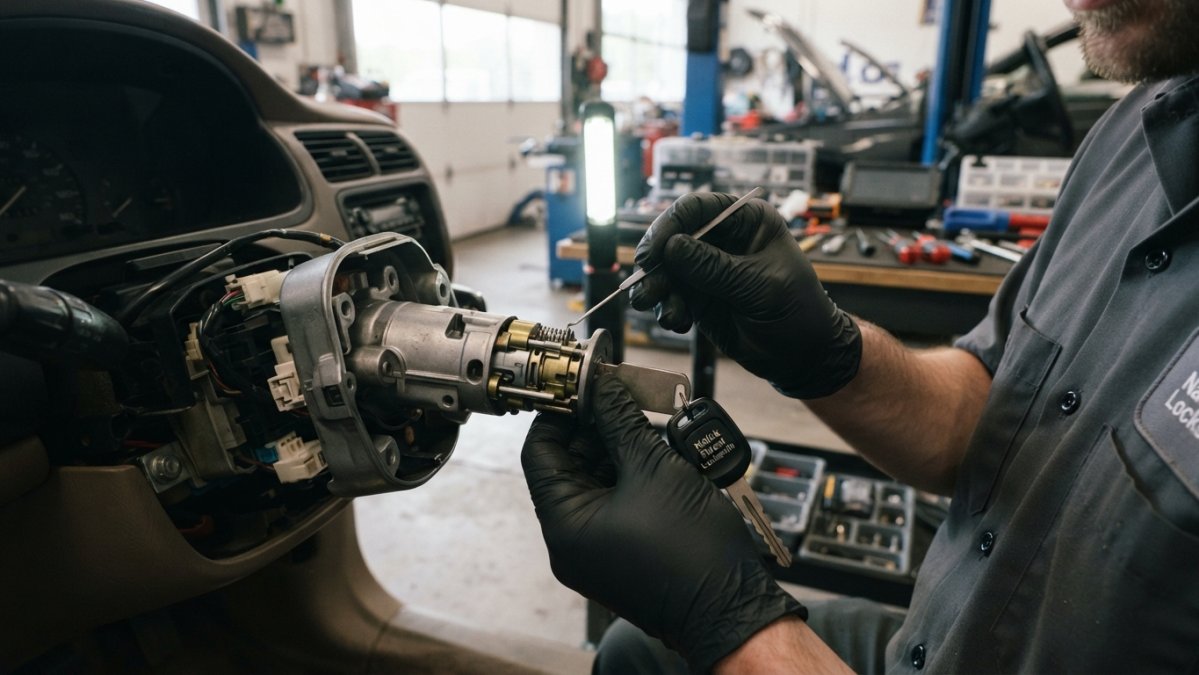
The key must be in the cylinder for this to work, turning it aligns the internal tumblers so the retaining clip releases.
Once the release pin is depressed, the cylinder slides out with light pressure.
Ignition Cylinder Replacement Without Key: What Changes
When the original key is missing, the standard release method fails: you can’t turn the cylinder to the accessory or run position, so the retaining pin never lines up with its access hole.
Why the Normal Method Fails
The retaining pin sits in a bore exposed only when the cylinder rotates. With no key, the tumblers stay engaged and the barrel won’t rotate. Picking works on some older, non-transponder designs, but modern wafer and sidebar cylinders resist it, and forcing rotation can snap the pin or crack the housing.
Extraction Methods a Locksmith Uses
A trained locksmith has several options, roughly in order of least to most destructive:
- Impressioning or picking. On older or low-security cylinders, the lock can be picked or impressioned with a blank, then turned to expose the pin. Fast and non-destructive when it works.
- Drilling the retaining pin. A small bit is used to drill just the pin, not the housing, so the cylinder can be pulled. This requires knowing the pin location and depth for the specific column.
- Drilling the cylinder face. On some designs the cylinder itself is drilled to release the tumblers, then extracted. The cylinder is destroyed, which is fine because it is being replaced.
- Housing removal. When the cylinder cannot be extracted in place, the lock housing or the upper column is removed and serviced on a bench.
Each step up the list adds time, risk, and cost. The airbag clock spring and steering-angle sensor sit close to the lock housing on many vehicles, so a slipped drill bit can turn a $200 job into a four-figure repair.
Tools and Equipment Involved
A no-key job typically requires:
- A pick set and tension wrenches for impressioning attempts
- A right-angle drill or a compact drill with a short bit for pin drilling
- A key-cutting machine or a programmed blank matched to the vehicle
Ownership Documentation You Will Need
No legitimate locksmith or dealer will cut a key or extract a cylinder without proof of ownership. Have these ready:
- Government-issued photo ID
- Vehicle title or current registration
- Proof of insurance, if the registration is not in your name
Expect the shop to record your ID and vehicle information, standard practice that protects both parties.
When to Stop and Call a Professional
Stop DIY work and call a locksmith or shop if any of these apply:
- The vehicle has a transponder key or immobilizer system
- You do not have the original key or a working duplicate
- The steering column contains airbag wiring you cannot identify
- You see melted, burned, or chafed wiring near the switch or column
A locksmith can often extract the cylinder without drilling using specialized picks, and can cut and program a new key in the same visit.
Never strike, pry, or force a keyless cylinder. The steering lock and airbag clock spring are directly behind it on many vehicles, and impact damage there can disable the airbag system.
If you’ve lost your key entirely, a mobile locksmith can extract the cylinder, cut a new key, and program it on site.
Step 3: Install, Rekey, and Test the New Cylinder
Installing the replacement cylinder reverses removal. Insert it into the lock housing with the key turned to the same position used for removal, push until the retaining pin clicks, then reconnect the electrical connector and apply a thin coat of dielectric grease.
Then comes the part that trips people up: rekeying and recoding.
- Rekeying matches the new cylinder’s tumblers to your existing key
- Recoding programs the transponder chip so the immobilizer recognizes the key
- Testing confirms the steering lock, accessory, run, and start positions all work
Turn the key through every position: the steering wheel should unlock, accessory should power the radio, and start should crank the engine. If the security light stays on, the immobilizer needs recoding with a scan tool or a locksmith’s equipment.
Test the new cylinder with the trim still off before you reassemble everything. If something’s wrong, you’ll catch it in five minutes instead of tearing the dash apart twice.
Ignition Cylinder Replacement Time and Cost: What to Expect
Most drivers want two numbers before committing: downtime and cost. Here’s a realistic breakdown based on common trade patterns.
Time.
Parts.
Labor.
Pricing depends on factors such as vehicle make and model, whether a transponder or immobilizer is involved, if the original key is available, the steering column design, trim condition, and parts source.
Ignition Lock Cylinder Replacement Cost Factors
| Factor | Why It Matters |
|---|---|
| Vehicle make and model | Parts availability and column complexity vary widely; some cylinders are dealer-only |
| Transponder or immobilizer | Recoding requires a scan tool or programmer and adds labor |
| Original key available | No-key jobs need extraction, a new key cut, and programming |
| Steering column design | Some columns require partial dash disassembly; others expose the pin in minutes |
| Trim condition | Brittle or previously damaged trim adds removal and replacement time |
| Parts source | OEM, aftermarket, and salvage cylinders differ in price and fitment |
Repair vs. Replace vs. Rekey
Before authorizing a full replacement, ask the shop which of these actually fits your situation:
- Rekey only. If the cylinder is mechanically sound but the key is worn or the tumblers are mismatched, a locksmith can rekey the existing cylinder to a new key. Usually the cheapest option.
- Replace the cylinder. Necessary when the barrel is worn, pins are broken, or the key will not turn even with a fresh cut.
- Replace the cylinder and switch. If the key turns freely but nothing electrical happens, the switch behind the cylinder may be the failed part. Replacing both at once avoids a second teardown.
- Replace the whole column. Rare, but some late-model columns integrate the lock housing and cannot be serviced separately.
When Insurance or Roadside Help Applies
If the failure was caused by a break-in attempt, vandalism, or a covered theft event, your comprehensive coverage may pay for the repair. Many auto clubs and roadside programs also cover lockout and ignition service, which can offset the cost of a no-key job. consumer resources from the Federal Trade Commission outlines your rights around repair estimates and authorization, which is worth reviewing before you sign anything.
Get a written estimate that separates parts, labor, and any programming or key-cutting fees. A quote that lumps everything into one number makes it impossible to compare shops fairly.
Frequently Asked Questions
Why is my key stuck in the ignition?
A key often sticks because the ignition lock cylinder’s pins are worn, the steering lock is engaged, or the key itself is bent or worn down. Try turning the steering wheel gently while wiggling the key. If it still won’t budge, the cylinder likely needs replacement. A worn key is a common culprit, so test a spare before assuming the cylinder is bad.
Can you replace an ignition lock cylinder without the original key?
Yes, but the process changes. Without the original key, you cannot turn the cylinder to the accessory position to release the retaining pin, so a locksmith may need to drill or pick the cylinder out. This takes longer and carries a higher risk of damaging the lock housing, which is why ignition cylinder replacement without key is best handled by a professional.
How long does it take to replace an ignition lock cylinder?
For a straightforward job on a common vehicle, ignition cylinder replacement time runs about 1 to 2 hours for a professional. If the original key is missing, or if dashboard trim and steering-column covers are difficult to remove, expect 2 to 3 hours. DIY attempts often take longer because of the learning curve and the risk of breaking plastic clips.
Does a new ignition lock cylinder need to be rekeyed?
Yes, in most cases. A replacement cylinder ships with a blank or generic keyway, so it must be rekeyed to match your existing key or paired with a new transponder key. If your vehicle has an immobilizer or security system, the new key also needs to be programmed to the car’s computer, or the engine will not start.
A failed ignition lock cylinder leaves you stranded, and the DIY route has real limits once keys, immobilizers, or airbags enter the picture. Natick Finest Locksmith handles ignition lock cylinder replacement for drivers across the Greater Boston area, with same-day service, 24/7 availability, and technicians who carry the tools for both keyed and no-key jobs. Call now and get your car starting again.