

Table of Contents
- What You’ll Need Before You Change Apartment Locks
- Can a Tenant Change Locks Without Permission?
- Requesting a Lock Change From Landlord: Step-by-Step
- How to Rekey Apartment Locks: A Legal DIY Process
- Cost to Rekey Apartment Locks and What Affects It
- Legal Consequences of Changing Apartment Locks Without Notice
- State Property Code Rules and Emergency Access Requirements
- Frequently Asked Questions
Last Updated: October 4, 2026
What You’ll Need Before You Change Apartment Locks
Changing the locks on a rental unit is legal in most cases, but only when you follow the right process. The rules depend on your lease and state law, and skipping either one can turn a simple security upgrade into a legal problem. This guide walks you through how to change apartment locks legally.
Before you touch a screwdriver, gather the basics. A missing document or a verbal agreement can stall the whole job.
Documents and Permissions Checklist
- Copy of your signed lease agreement
- Written permission from your landlord, if required
- Your state’s property code or landlord-tenant statute
Keep every document in one folder for a clear paper trail if a dispute arises.
Can a Tenant Change Locks Without Permission?
The short answer is usually no, not without limits. Most states let tenants change or rekey locks for their own safety, but only if they give the landlord a copy of the new key.
A lock change is about access, not ownership: you’re protecting your unit, but your landlord still needs a way in for emergencies and repairs.
Changing the locks and keeping the only key is one of the fastest ways to trigger an illegal lockout claim against you. In many states, withholding access is treated as a serious lease violation, even if you paid for the new lock yourself.
Check three things before you act:
- What your lease says about locks and keys
- What your state’s landlord-tenant law allows
- Whether your landlord wants a key, a code, or both
Requesting a Lock Change From Landlord: Step-by-Step
Most disputes start with a request never made in writing. Here’s the process we recommend.

Changing Locks on Your Rental Property: What Landlords Should Know
Fast Eviction Service
- Check your lease first. Look for clauses on locks, keys, and security.
- Write a short request. State the reason, the fix, and who pays.
- Send it in writing. Email or certified mail both work.
- Give a deadline. Ask for a response within a set number of days.
- Offer to split or cover the cost. This speeds up approval.
- Keep a copy. Save the email or receipt.
- Follow up once. A single polite nudge is enough.
Template Letter for Landlord Lock Change Requests
Dear [Landlord/Property Manager Name],
I’m writing to request permission to change the locks on [unit address]. The current lock [reason: is worn / a former roommate still has a key / was damaged].
I plan to hire a licensed locksmith to [rekey / replace] the lock. I will provide you with a copy of the new key within [X] days.
How to Rekey Apartment Locks: A Legal DIY Process
Rekeying is cheaper than replacing a lock and keeps your existing hardware. It swaps the internal pins so old keys stop working. Here’s the legal DIY path, assuming you have permission.

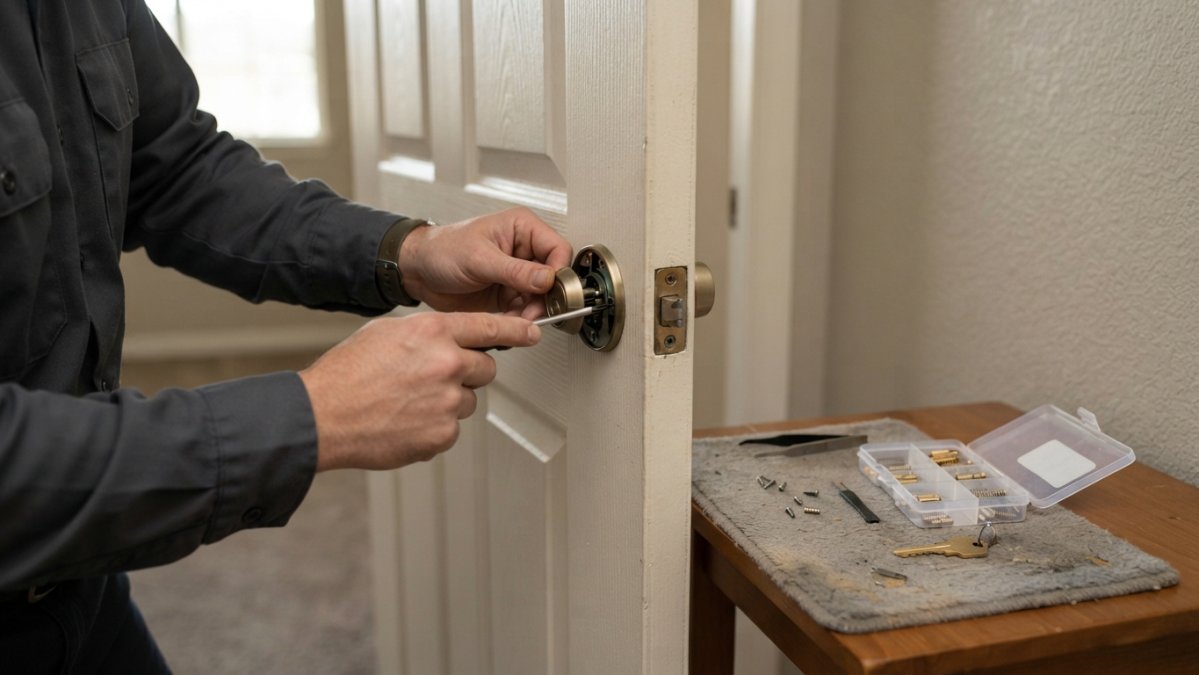
- Confirm permission. No written approval, no work.
- Gather tools. Screwdriver, rekey kit, new pins, and a key.
- Remove the lock. Unscrew the deadbolt or knob from the door.
- Swap the pins. Follow the kit’s key-specific instructions.
- Reassemble and test. Try the old key, then the new one.
- Give the landlord a key. Do this within the agreed window.
A common mistake is buying a rekey kit for the wrong lock brand. Match the kit to the cylinder or it won’t work.
Photograph each step as you disassemble the lock. If a spring or pin goes missing, the photo shows you exactly where it belongs, and you avoid a second trip to the hardware store.
Smart Lock Integration and Insurance Implications
Smart locks add convenience but change the legal picture: a landlord may need a physical key for emergency access, and some leases ban them outright. Check before you buy. Insurance matters too, if a break-in happens and the lock wasn’t installed to code, a claim could be denied. Keep your receipt and approval on file.
Cost to Rekey Apartment Locks and What Affects It
The cost to rekey apartment locks depends on a few factors, so most locksmiths quote after seeing the job. Expect these to move the number:
- Lock type (deadbolt, knob, or both)
- Number of locks or units
- Brand and cylinder style
For a single unit, rekeying is almost always cheaper than replacing hardware; for many units, a scheduled rekeying route lowers the per-unit cost. Call Natick Finest Locksmith for a quote.
Legal Consequences of Changing Apartment Locks Without Notice
Skipping notice cuts both ways: a tenant who locks out a landlord faces one set of consequences, a landlord who locks out a tenant a different, often harsher, set.
If You Are the Tenant
Changing the lock without permission or without providing a key is usually a lease violation, not a crime, but the effects can be severe:
- Cure-or-quit notice. Most state landlord-tenant statutes let the landlord serve written notice giving you a set number of days (commonly 3 to 14) to restore access. Fail to cure, and the landlord can file for eviction.
- Eviction filing on your record. Even if you cure before the hearing, a filed eviction case can appear in tenant-screening databases and follow you to future applications.
- Forced-entry damages. If the landlord calls a locksmith to regain access, the service call, new lock, and any damaged door or frame are typically chargeable to you, as a lease violation fee or deducted from your security deposit.
Withholding the only key is the single fact pattern that most reliably converts a routine lease dispute into an eviction filing. Even tenants who paid for the lock themselves lose this argument in most jurisdictions because access, not ownership, is the legal issue.
If You Are the Landlord
Locking a tenant out without following the legal process is far riskier, and most states treat it as an unlawful self-help eviction:
- Statutory penalties. Many states impose daily penalties for each day the tenant is locked out, in addition to actual damages. A few allow the tenant to recover attorney’s fees.
- Reinstatement and damages. Courts can order immediate restoration of possession plus compensation for hotel costs, spoiled food, lost wages, and emotional distress.
- Criminal exposure in some states. A handful of jurisdictions treat unlawful lockouts as a misdemeanor when they involve force, threats, or a tenant who is elderly or disabled.
The Paper Trail That Decides These Cases
In practice, the outcome usually turns on documentation, not on who was right. The party who can produce these tends to prevail:
- A dated written request or notice
- Proof of delivery (email read receipt, certified mail slip, or text thread)
- A receipt from a licensed locksmith showing the date of service
A common pattern in court: the tenant who sent one polite email and kept the reply wins, while the tenant who acted silently and kept the only key loses, even when the safety concern was legitimate.
Remedies If You Are the One Locked Out
If you are a tenant locked out without a court order, the fastest path is usually:
- Call a locksmith to regain entry. Keep the receipt; it becomes evidence of damages.
- Document everything. Time-stamped photos of the door, the new lock, and any notice posted.
- Send a written demand. State the date of the lockout, the statute you believe was violated, and the amount you are seeking.
- Contact your local housing authority or legal aid office. Many provide same-week help for lockout cases at no cost.
- File in small claims or housing court. Most states have an expedited track for unlawful lockout claims.
If you are a landlord and a tenant has changed the lock without providing a key, the correct move is a written cure-or-quit notice, never a self-help lockout, which converts a winnable lease violation into a statutory penalty against you.
State Property Code Rules and Emergency Access Requirements
Every state’s landlord-tenant statute addresses access differently. Understanding your state’s mechanism tells you what you actually have to do, and what your landlord can and cannot demand.
The Three Common Statutory Models
Most state property codes fall into one of three patterns for tenant-initiated lock changes:
- Permission-plus-key model. The tenant may change or rekey the lock but must give the landlord a copy of the new key. This is the most common approach; failure to provide the key is itself a lease violation.
- Written-consent model. The lease or statute requires the landlord’s written approval before any change. A verbal ‘sure, go ahead’ is not enough if a dispute later arises.
- Prohibition-with-exception model. Lock changes are barred except in narrow circumstances, typically a protective order, documented domestic violence incident, or police report. Several states allow survivors to change locks without landlord consent, provided they give notice and sometimes a copy of the order.
Before you buy hardware, identify which model your state uses. The answer determines whether you need a signature, a key copy, or a court document, and getting it wrong is the most common reason a legitimate lock change turns into a lease violation.
Emergency Access: What Landlords Are Actually Required to Have
Emergency access rules are usually a landlord obligation, but they shape what you can install:
- Fire and life-safety access. Most state fire and property maintenance codes require a landlord to enter a unit in an emergency without tenant cooperation. A deadbolt only the tenant can open from outside can violate this in some jurisdictions.
- Police and medical response. Officers responding to a welfare check or medical call generally need a key, a code, or legal authority to force entry. Landlords who cannot provide access may face liability if response is delayed.
- Required repairs. If a tenant requests a repair then denies access, most statutes allow entry after proper notice, but only through the legal process, not by drilling the lock.
If your lease or state code requires the landlord to hold a key, plan for it before you install anything. The two compliant options are a duplicate key delivered in a sealed, dated envelope with a receipt, or a smart lock with a time-limited emergency code you can audit.
Notice Requirements for Landlord Entry
Separate from lock-change rules, most states require landlords to give advance written notice before non-emergency entry, commonly 24 to 48 hours, though some allow 12 hours for certain repairs and a few require up to 72. Notice is typically waived for genuine emergencies like fire, flood, gas leak, or a medical event. A landlord who cannot give proper notice may still demand a key: the key and notice requirements are separate legal obligations, and satisfying one does not excuse the other.
How to Find Your State’s Exact Rule
Rather than rely on a summary, pull the primary source:
- Search your state’s official legislature website for the landlord-tenant chapter of the state code. Look for sections titled ‘Access,’ ‘Right of Entry,’ or ‘Locks and Keys.’
- Check your state attorney general’s office for a tenant-rights handbook. Most publish one and update it annually.
- Check your city or county code as well. Some municipalities layer additional rules on top of state law, particularly around fire access and short-term rentals.
- Read your lease’s security clause against the statute. A lease term that conflicts with a mandatory state rule is generally unenforceable, but you may have to raise that in writing to enforce it.
State landlord-tenant statutes and tenant-rights handbooks
Special Protections You Should Know About
A growing number of states have carved out lock-change rights for survivors of domestic violence, stalking, or sexual assault. These statutes typically allow the tenant to change the lock without landlord consent, require notice within a set window, and sometimes require a copy of a protective order or police report. If you are in this situation, contact a local legal aid office before you act, the procedural requirements are strict.
Save a PDF of your state’s relevant statute and your lease’s security clause in the same folder as your written request. If a dispute ever reaches a hearing, having both documents side by side is the fastest way to show which rule controls.
Frequently Asked Questions
Are you allowed to change the locks in your apartment without asking?
No. In most states, a lease agreement requires written permission from the landlord before you change apartment locks. Doing it without notice can violate landlord-tenant law and lead to a breach of contract claim. Even if you feel unsafe, the legal path is to request a lock change first. If the landlord refuses, you may have a legal remedy under state property code, but you must follow the statutory process rather than acting alone.
Is it cheaper to rekey or change locks?
Rekeying is generally cheaper than replacing the entire lock because you only pay for new pins and labor, not a new deadbolt or handle set. The cost to rekey apartment locks depends on the number of cylinders, lock type, and whether you need after-hours service. Replacing locks costs more because you buy new hardware. For most renters, rekeying is the practical choice, but confirm with your landlord first, since some leases require matching hardware or specific security measures.
What happens if I change the locks without telling my landlord?
Changing locks without notice can be treated as an illegal lockout or unauthorized entry risk under landlord-tenant law. Consequences may include a breach of contract claim, deductions from your security deposit, or civil liability if the landlord or emergency personnel cannot access the unit. Some states allow the landlord to rekey the unit back and charge you for it. The safer route is to submit a written request, keep a copy, and wait for approval before any work begins.
Can my landlord refuse to change the locks if I feel unsafe?
A landlord can refuse a routine lock change request, but many state property codes require them to act when there is a documented safety threat, such as a restraining order or a former roommate who kept a duplicate key. If they refuse, send a written notice citing the specific statute and give a reasonable notice period. If they still do not respond, you may have grounds to change the locks yourself and deduct the cost, but only after following the statutory requirements for your state.