

Table of Contents
- Why Professional Lock Installation Matters for Home and Business Security
- DIY vs. Professional Lock Installation: What the Hardware Store Doesn’t Tell You
- Common Door Lock Installation Mistakes and How to Spot Them
- Choosing the Best Locks for Home Security: A Room-by-Room Guide
- What Lock Installation Cost Really Covers (and When It’s Worth It)
- How Professional Locksmiths Handle Non-Standard Doors and Frames
- Code Compliance, Fire Doors, and Insurance: What You Need to Know
- How to Vet a Locksmith and Verify Installation Quality
- Frequently Asked Questions
Last Updated: October 17, 2026
Why Professional Lock Installation Matters for Home and Business Security
A door lock is only as strong as the hole it sits in. That is the uncomfortable truth behind why professional lock installation matters: the lock on the shelf may be excellent, but if the bore hole is off by a few millimeters, the deadbolt never fully seats and the door is weaker than it looks. At Natick Finest Locksmith, we see this constantly on service calls across the Greater Boston area.
Here’s the part most guides skip: professional lock installation is the practice of fitting lock hardware to a specific door, frame, and strike plate so the bolt engages fully, the mechanism stays aligned, and the lock holds up under daily use. The hardware is half the job. The fit is the other half.
Below, we break down what goes wrong with DIY work, how to choose locks room by room, what installation actually involves, and how to check the finished job.
A lock that doesn’t fully seat in its strike plate can often be pushed open with a firm shove, no tools required. The bolt has to travel its full depth.
The Hidden Risks of a Poorly Fitted Lock
Most lock failures we see aren’t broken locks. They’re misaligned ones.
When a deadbolt doesn’t line up with its strike plate, the bolt rests partly in the frame instead of fully extended. That shortens the throw, and a short throw is easy to defeat. The same misalignment wears the lock mechanism from the inside. Parts grind, springs weaken, and the lock starts failing months later, usually at the worst possible moment.
Then there’s the damage you can’t see. Drilling a new bore hole in the wrong spot leaves the door with two holes, a weakened edge, and a lock that never sits flush. On a hollow-core or thin door, an oversized hole can compromise the door’s structure.
For a business, a jammed lock during open hours means staff locked out and customers turned away. For a landlord, a sloppy install becomes a maintenance ticket every few months.
DIY vs. Professional Lock Installation: What the Hardware Store Doesn’t Tell You
Retail lock kits come with a template and a paper guide. What they don’t come with is a way to fix a door that’s slightly warped, a frame that’s out of square, or a backset that doesn’t match the old hardware.
DIY installation works fine in one scenario: a standard door, an existing hole in good shape, and a direct swap of the same lock type. Anything outside that box gets risky fast.
Here’s what the box doesn’t mention:
- Backset matters. The distance from the door edge to the center of the hole has to match your new lock. Get it wrong and you’re drilling new holes.
- Door thickness varies. Thin interior doors and thick exterior doors need different hardware.
- Strike plates need adjusting. The plate on the frame often needs to be mortised deeper or shifted for the bolt to seat.
- Weather and settling shift doors. A door that fit last year may not line up now.
Professional installation accounts for all of this before the drill comes out. It also means the job is done in one visit, with the right tools, and backed by someone you can call if something’s off.
Common Door Lock Installation Mistakes and How to Spot Them
The mistakes repeat. After enough service calls, you start recognizing the same handful of problems.

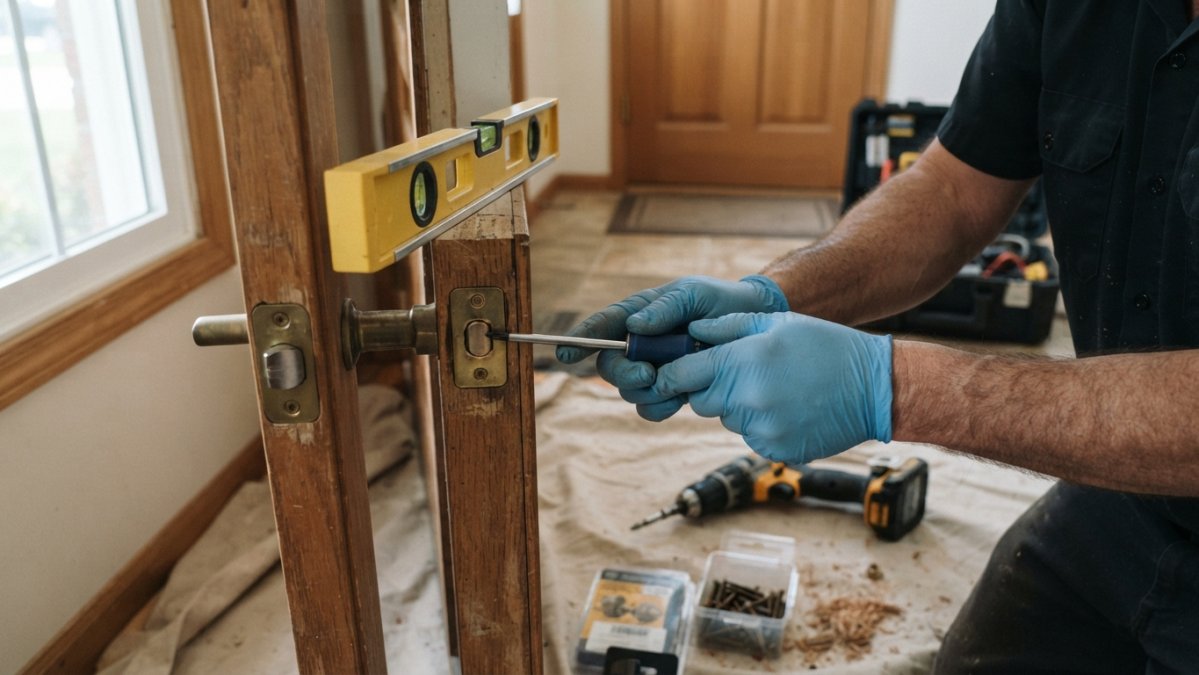
1. Drilling the bore hole too high or too low. The deadbolt and handle no longer line up with the strike plate.
2. Skipping the pilot hole for screws. Screws split the door edge or strip out. The lock feels loose within weeks.
3. Not checking the door frame for rot or cracks. A deadbolt screwed into soft wood won’t hold.
4. Over-tightening the cylinder. The lock binds, and the key turns hard or sticks.
5. Ignoring the gap between door and frame. Too wide a gap lets the bolt miss the plate. Too narrow and the door rubs.
6. Reusing old screws and hardware. Worn screws and mismatched parts cause alignment drift.
How to spot a bad install: the key sticks, the bolt drags, the door needs a shove to latch, or the lock wiggles when you touch it.
If your door needs a shoulder shove to latch, the strike plate is misaligned. Left alone, the bolt and plate grind each other down until the lock stops engaging altogether.
Choosing the Best Locks for Home Security: A Room-by-Room Guide
The best locks for home security depend on the door, not the budget. A high-security lock on a flimsy interior door is wasted money.
Front and back entry doors: A Grade 1 or Grade 2 deadbolt with a solid strike plate and 1-inch bolt throw.
Side and garage entry doors: A keyed deadbolt plus a reinforced strike plate. These doors are often out of sight and get less attention.
Interior doors to bedrooms and home offices: Privacy locks are fine for most rooms. For a home office holding equipment, a keyed entry lock makes sense.
Sliding doors: A secondary lock plus a charley bar or pin. Standard latches on sliders are weak.
Apartment and rental units: A deadbolt plus a secondary lock, installed so it’s code-compliant and lease-friendly. More on that below.
For businesses, the room-by-room logic shifts to access control: master key systems, restricted keyways, and locks that log who entered and when.
What Lock Installation Cost Really Covers (and When It’s Worth It)
Lock installation cost isn’t just labor. It covers the assessment, the tools, the hardware fitting, and the follow-up if something needs adjusting.
What drives the price up or down:
- Lock type. A standard deadbolt is simpler than a high-security lock or a smart lock.
- Door condition. A clean, standard door is quick. A warped door, a damaged frame, or a non-standard size takes longer.
- Number of locks. Rekeying or replacing locks across multiple doors is more efficient as a batch.
- Access and timing. Emergency or after-hours calls cost more than scheduled appointments.
Pricing varies by job, so we quote each one based on the door, the hardware, and the scope. Call us or check our site for a current quote rather than guessing from a generic range.
When is professional installation worth it? When the door isn’t standard, when the lock is high-security, when it’s a rental with lease and code rules, or when the door is a fire door. In those cases, a mistake costs more to fix than the install would have cost upfront.
How Professional Locksmiths Handle Non-Standard Doors and Frames
Standard doors are the easy case. The hard cases are where experience shows.
A non-standard door frame might be out of square, undersized, or built from material that won’t hold a standard strike plate. Older homes often have doors that have settled, warped, or been patched. Commercial doors may be metal, fire-rated, or fitted with closers that change how the lock has to sit.
Here’s how a professional handles it:
- Measure the door and frame first. Backset, thickness, and gap all get checked before any hardware is chosen.
- Match the hardware to the door. Some doors need a different lock body, a deeper mortise, or a wrap plate to reinforce a damaged edge.
- Adjust the strike plate, not the lock. Shifting or mortising the plate is usually cleaner than re-drilling the door.
- Reinforce weak points. A frame with soft wood gets a reinforcement plate or a longer strike.
- Test the full cycle. Key in, bolt out, bolt in, key out, door closed. Every time.
Non-standard doors are also where DIY goes wrong most often. The template assumes a standard door. Yours isn’t one.
Code Compliance, Fire Doors, and Insurance: What You Need to Know
Locks touch building codes, fire safety, and insurance in ways most homeowners never think about. Get it wrong and the consequences go beyond a sticky lock.
Fire doors are the big one. A fire-rated door has to latch and close on its own, and the hardware can’t be altered in a way that defeats that.
Renters and leases. If you’re renting and your landlord won’t upgrade the locks, changing them yourself can create lease problems. Many leases require the landlord to hold a key or approve changes.
Accessibility. Locks and handles on doors along an accessible route have to meet accessibility standards for operation (Chapter 3: Operable Parts).
Insurance. Some policies ask about lock types on entry doors, and a claim can be affected if the locks weren’t up to the policy’s stated standard.
For official details, check the U.S. Access Board accessibility guidelines on door hardware and operable parts, and your local building department for fire door rules.
How to Vet a Locksmith and Verify Installation Quality
Hiring the wrong locksmith is its own risk. Here’s how to check a provider before you book, and how to verify the work after.
Before you book:
- Ask for the license and insurance. A legitimate locksmith carries both.
- Confirm the business address and phone number are real and local.
- Get a written quote before work starts, not after.
- Ask what happens if the lock needs adjusting later.
- Check reviews for complaints about no-shows or surprise charges.
After the install, run this check:
- The key turns smoothly with no binding.
- The bolt extends fully into the strike plate.
- The door latches with a light push, no shove needed.
- The lock doesn’t wiggle when you grip and twist it.
- The strike plate screws are tight and the plate sits flush.
- The door opens and closes without rubbing the frame.
- You have the right number of keys, and the old keys no longer work if the lock was rekeyed.
If any box is unchecked, call the installer back. A good locksmith will fix it without a fight.
Test the bolt with the door open first. Turn the key and watch the bolt extend. If it doesn’t travel its full length, the problem is the lock, not the strike plate. That narrows down the fix in seconds.
A lock that drags, sticks, or needs a shove is telling you the installation is off, and that’s a security problem, not an inconvenience. Natick Finest Locksmith handles professional lock installation, rekeying, and repair for homes and businesses, with same-day service, experienced technicians, and code-compliant work backed by our LLC and Yankee Security Certificates. We’re available every day, any time, for scheduled appointments and emergencies alike. Call Natick Finest Locksmith and get locks that seat, hold, and last.
Frequently Asked Questions
What can go wrong when a lock is installed incorrectly?
A poorly installed lock can misalign the deadbolt and strike plate, making the door hard to lock or easy to force open. It may also weaken the door frame, void the lock’s warranty, and lead to repeated lock repair costs. In some cases, incorrect installation violates fire or building codes. Professional lock installation ensures precise alignment, proper hardware compatibility, and reliable operation, avoiding these long-term issues.
Is it better to hire a locksmith or install a lock yourself?
For standard knob or deadbolt swaps on a sound door, a confident DIYer can manage. But most door lock installation mistakes come from inaccurate measuring, drilling, and alignment, especially on non-standard frames. A professional locksmith brings specialized equipment, checks door fit, and ensures code compliance. If you have a high-security lock, a fire-rated door, or a rental property, professional installation is worth the lock installation cost.
How can you tell whether a door lock was installed properly?
Test the lock several times: the key should turn smoothly without force, the deadbolt should extend fully into the strike plate, and the door should not rattle or shift when locked. Check that the faceplate sits flush and screws are tight. Look for gaps around the cylinder and ensure the door frame is not cracked. If you notice any of these issues, call a professional locksmith to inspect and correct the installation.
When should homeowners replace or upgrade their locks?
Replace or upgrade locks after moving into a new home, after a breakup or lost keys, or if your current locks lack bump-resistant or pick-resistant features. Older homes with basic builder-grade locks benefit from high-security deadbolts. Also upgrade if you see wear, sticking, or damage. A locksmith can perform a security consultation to recommend the best locks for home security based on your door types and risk level.