
Table of Contents
- Why Verifying Locksmith Credentials Matters
- How to Check Whether a Locksmith Is Licensed
- Locksmith License Lookup: Interpreting the Record
- Separate Checks for the Company and the Technician
- Locksmith Insurance Verification and Proof of Ownership Requirements
- Questions to Ask a Locksmith Before Hiring
- What to Do When a License Cannot Be Verified
- Conclusion
- Frequently Asked Questions
Last Updated: October 16, 2026
Why Verifying Locksmith Credentials Matters
Learning how to verify locksmith professional credentials is the best way to protect yourself from scams, overcharging, and shoddy work.
Locksmithing is lightly regulated in many states, so anyone with a drill, a pick set, and a phone number can advertise as a locksmith.
Verification fixes that. A licensed, insured locksmith has a paper trail you can check before they arrive: a state license number, a registration record, and proof of insurance.
Verification is a pre-arrival task, not a doorstep task. Do your checking while you’re still on the phone, before anyone is standing at your door with a drill.
How to Check Whether a Locksmith Is Licensed
Checking a locksmith’s license means finding your state’s licensing authority, searching its official database, and matching the record to the person and company you’re hiring.
Not every state requires a locksmith license. Some regulate through a state board, others leave it to cities and counties, and a few have no statewide requirement. That’s the first thing to figure out.
Finding Your State Licensing Authority
Start with your state’s consumer protection office or Department of Public Safety. A quick search for “locksmith license” plus your state name usually lands on the right page. Bookmark it, you’ll return every time you hire.
Searching an Official License Database
Most licensing authorities run a public lookup tool. Search each of these separately:
- The locksmith’s license number
- The company’s legal business name
- The technician’s full name
A company can hold a license while the individual at your door holds none, and the reverse is also true.
Never accept a license number that only appears on the technician’s business card. Anyone can print a card. The number has to match a record in the state’s own database.
Locksmith License Lookup: Interpreting the Record
A locksmith license lookup returns a record, not a verdict. It tells you whether the license is active, when it expires, and what work the holder may do.
Here’s what each field means:
| Record Field | What It Tells You | Red Flag |
|---|---|---|
| License status | Active, expired, suspended, or revoked | Anything but “active” |
| Expiration date | When the license must be renewed | A date in the past |
| License class | The type of work permitted | Class doesn’t cover your job |
| Legal business name | The registered company name | Doesn’t match the van or invoice |
| Registration number | Unique ID for the business | No record found |
| Issue date | When the license was first granted | Issued days ago on a long-established company |
| Disciplinary actions | Complaints, fines, or suspensions on file | Any open or recent action |
You want an active status with a current expiration date.
The legal business name matters more than people think. If the van says one name and the state record says another, you’re likely dealing with an unlicensed operator using a borrowed or invented identity.
Reading the Status Field Correctly
Status is the most misread field. “Active” means valid today; “expired” means the renewal lapsed but may be reinstated; “suspended” means the regulator paused it, usually pending an investigation; “revoked” means it was taken away and the holder may not work under it.
A license can show “active” with a disciplinary action listed separately, so read the whole record. A resolved complaint from years ago differs from an open action tied to fraud or unlicensed activity.
When Fields Are Missing or Inconsistent
State databases aren’t always complete. A blank expiration date, a missing class, or a name that doesn’t match the license number are signals to slow down, not guess.
- Blank expiration date: Call the licensing authority and ask them to confirm the current status. Do not assume the license is valid.
- Missing class: Ask the regulator which class covers your job, rekeying, lock installation, automotive, safe work, or access control are often separate scopes.
- Name mismatch: Ask the locksmith to explain the difference in writing. A DBA (“doing business as”) name is normal; a completely unrelated legal name is not.
A record that returns “no results” is not the same as a record that shows “expired.” One means the state has no license on file under that number or name. The other means a license existed and lapsed. Both are reasons to pause, but only the second tells you the person was once credentialed.
Matching the Record to the Person at Your Door
The record only helps if it matches the person who shows up. Before work starts, compare three things:
- The name on the state record against the technician’s photo ID.
- The company name on the record against the van, invoice, and business card.
- The license number on the record against the number the technician gives you verbally.
If any don’t line up, stop and call the licensing authority before work begins. A legitimate technician will wait; someone who pressures you to skip the check is telling you what the record would show.
state consumer protection and licensing lookup portals
Separate Checks for the Company and the Technician
A licensed company does not guarantee a licensed technician, and vice versa. You need both records to match.
A legitimate operation has two layers of credentials:
- The business license covers the company, its registration number, and its standing with the state.
- The individual license covers the technician at your door.
Ask for both, verify both, and confirm the names connect, either the technician is listed as an employee or the company is authorized to dispatch licensed staff. If the person at your door can’t produce a license number matching an active state record, stop the job.
Locksmith Insurance Verification and Proof of Ownership Requirements
Locksmith insurance verification protects you if the technician damages your door, lock, or property. Ask for a certificate of insurance and confirm the policy is current.
Look for two types of coverage:
- General liability, which covers property damage
- Workers’ compensation, which covers injury to the technician on your property
The certificate should list the insurer, policy number, coverage dates, and business name. Call the insurer if anything looks off, a real policy is easy to confirm.
Proof of ownership requirements work differently.
Keep a photo of your vehicle registration and a recent utility bill on your phone. It speeds up proof of ownership checks during an emergency and gets you back inside faster.
Questions to Ask a Locksmith Before Hiring
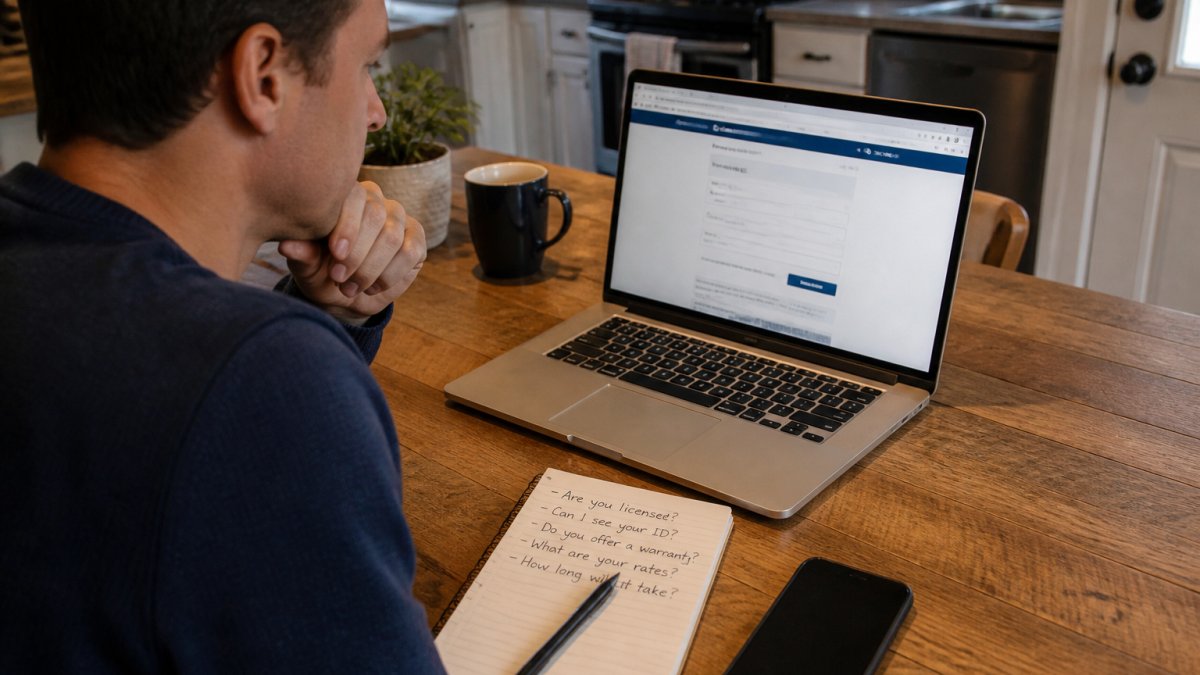
The right questions to ask a locksmith before hiring cover licensing, insurance, pricing, and identity. Ask them on the phone before you commit, and write down the answers:
- What is your state license number?
- Is the technician coming to my address licensed individually?
- Can you send a certificate of insurance before you arrive?
A legitimate locksmith answers all six without hesitation. Evasive answers, pressure to skip the questions, or refusal to give a license number are reasons to hang up.
For urgent calls, also ask how soon they can actually arrive, a realistic window beats an inflated promise. At Natick Finest Locksmith, our technicians are available every day of the week at any time, and we give a straight answer on arrival time.
What to Do When a License Cannot Be Verified
When a license cannot be verified, do not hire that locksmith. No active record means no proof the person is qualified, insured, or accountable to a regulator. The hard part is what to do next, especially if you’re locked out, it’s late, and the technician is already at your door. Work through these steps in order.
1. Pause the Job Before Any Work Starts
You are not obligated to let an unverified technician begin. Say plainly that you need to confirm the license before any work proceeds. A legitimate provider will wait; if the technician refuses, pressures you, or starts drilling anyway, end the interaction and ask them to leave.
If work has already started and the credentials don’t check out, you can still stop the job. You may owe for work already performed, but you are not required to authorize more.
2. Re-Check the Number Yourself
Ask for the license number again and search it yourself on the state’s official lookup. Common reasons a first search fails:
- The number was transcribed wrong over the phone.
- The technician gave a business registration number instead of an individual license number.
- The license is registered under a different legal name than the one on the van.
If the second search also returns nothing, treat the credential as unverified and move on.
3. Request Alternate Documentation
If your state does not license locksmiths at all, ask for the next-best proof:
- A certificate of general liability insurance with the business name and policy number.
- A workers’ compensation certificate if the technician will be on your property.
- A local business license or registration from the city or county.
None replace a state license where one is required, but they establish that a real, accountable business exists.
4. Find a Verifiable Provider Instead
Look for a company with a physical local address, a consistent business name across its website and listings, and a license number published openly rather than only on request. Run the same checks before you agree to anything, a short delay beats an unverified technician in your home.
5. Document Everything If You Suspect Fraud
If you believe you were targeted by an unlicensed or fraudulent operator, the paper trail matters. Keep:
- The invoice and any written estimate.
- The business card and any text or email messages.
- Photos of the vehicle, the technician’s ID if shown, and the work performed.
6. File a Complaint With the Right Regulator
Where you file depends on who regulates the trade in your state:
- State licensing board or department: If a license was required and the person had none or misrepresented one.
- State attorney general or consumer protection office: For deceptive pricing, bait-and-switch quotes, or fraud.
- Local police: If you believe a crime occurred, such as property damage or theft.
Include the license number the technician gave you, even if it didn’t check out, regulators use those numbers to trace repeat offenders.
The uncomfortable truth is that unlicensed providers count on you not checking. A ten-minute lookup removes their advantage, and if the check fails, the documentation you keep is what lets a regulator act.
FTC complaint assistant for reporting deceptive business practices
Conclusion
Verifying credentials takes a few minutes, but it’s the difference between a locksmith who protects your home and one who takes advantage of a bad moment.
Natick Finest Locksmith is LLC and backed by Yankee Security Certificates. Our experienced technicians respond fast, work to code, and show up with the tools to finish the job the same day.
Call Natick Finest Locksmith and get a technician who can prove their credentials before they knock.
Frequently Asked Questions
Does a locksmith ask for proof of ownership?
Yes, a legitimate locksmith will ask for proof of ownership or residency before opening a lock or making a key. This protects you and the locksmith from liability. Acceptable documents include a driver’s license with your address, a lease agreement, a utility bill, or a vehicle registration for car lockouts. If a locksmith does not ask for any proof and proceeds immediately, that is a red flag. Professional locksmiths follow proof of ownership requirements to prevent unauthorized access and comply with state regulations.
How can I verify a locksmith’s professional credentials?
Start by asking for the locksmith’s license number and the name of the issuing state authority. Then visit your state’s official licensing database and search for that number. Confirm the license status is active, check the expiration date, and verify the business name matches. Ask for a certificate of insurance and call the insurer to confirm the policy is current. Finally, match the technician’s photo ID to the name on the license record when they arrive. This process takes about ten minutes and helps you avoid unlicensed providers.
What should I do if a locksmith cannot verify their credentials?
If a locksmith cannot provide a license number, insurance certificate, or matching identification, do not let them work on your locks. Cancel the service and contact a different provider. You can also report the incident to your state licensing authority or consumer protection office. In urgent situations, call a locksmith company with a verifiable business profile and ask them to confirm credentials over the phone before dispatch. Never feel pressured to proceed just because someone arrived at your door.
Should I ask a locksmith for proof of insurance?
Yes, always ask for proof of insurance before any work begins. A current insurance policy covers damage to your property if something goes wrong during the job. Request a certificate of insurance and verify the policy is active by calling the insurance company directly. Locksmith insurance verification protects you from paying out of pocket for accidental damage. If a locksmith cannot show proof of insurance, hire someone else. This step is especially important for commercial jobs or high-value residential properties.