

Table of Contents
- Why Rekeying Multiple Rental Property Units Beats Replacing Locks
- When to Rekey Locks Between Tenants (and Why It Matters)
- A Rental Property Lock Change Checklist for Every Turnover
- Key Control for Property Managers: Preventing Unauthorized Copies
- Master Key System for Rental Properties: Scaling Access Across Units
- How to Rekey Multiple Units at Once: A Step-by-Step Workflow
- Frequently Asked Questions
Last Updated: October 12, 2026
Why Rekeying Multiple Rental Property Units Beats Replacing Locks
Rekeying multiple rental property units is the practice of changing the internal pins of existing lock cylinders so old keys stop working, rather than installing brand-new lock hardware.
The core idea is simple. You keep the lock body. You change what makes it open.
That matters because locks are rarely the problem. Keys are.
A full lock replacement solves the same problem, but you pay for hardware you already own. Rekeying reuses the cylinder and changes only the pin configuration inside it.
- Cost: you buy labor and pins, not new locks
- Speed: a single cylinder takes minutes to rekey
- Fit: existing doors, finishes and hardware stay matched
- Security: every old key becomes dead metal
How Rekeying Invalidates Old Keys
A lock cylinder is the rotating barrel inside the lock that accepts the key. Inside sit spring-loaded pins of different lengths.
Rekeying swaps those pins for a different combination. The old key now lifts the pins to the wrong heights, so the cylinder will not rotate.
That is the whole trick. No new hardware, no new holes in the door.
When to Rekey Locks Between Tenants (and Why It Matters)
Rekeying locks between tenants should happen at every turnover, every time, without exception. A vacated property with un-rekeyed locks is an open invitation, and you cannot prove who holds a key.
Some landlords rekey only when a key is reported lost. That is a mistake. Keys get copied quietly, shared with roommates, and handed to friends.
A turnover rekey is cheap insurance. It closes the gap between one tenant’s access and the next tenant’s privacy.
Skipping a turnover rekey because “the tenant seemed trustworthy” is the most common and most expensive shortcut. If a break-in happens later and the old key fits, you own the liability and the repair bill.
Tenant Turnover Triggers That Require a Rekey
Any of these events should trigger a rekey before the next move-in:
- A tenant moves out or breaks a lease
- A key is lost, stolen, or never returned
- A roommate leaves but the lease continues
- A unit is vacated after an eviction
- A master key goes missing
- You take over management of an occupied building
Treat this list as a floor, not a ceiling. When in doubt, rekey.
A Rental Property Lock Change Checklist for Every Turnover
A rental property lock change checklist keeps turnovers consistent, so nothing gets skipped when you are juggling ten doors in one week. Build it once, then run it every time.
- Confirm the unit is fully vacated and keys are collected
- Count every exterior door and note each lock type
- Check that all cylinders are compatible with your rekey kit
- Rekey all exterior locks, not just the front door
- Test each lock with the new key, then with an old key
- Record the new key configuration in your log
- Hand off new keys and get a signed receipt
- Store one labeled spare per unit in a locked cabinet
The old-key test is the step people skip. If an old key still turns, the rekey failed.
Key Control for Property Managers: Preventing Unauthorized Copies
Key control for property managers means limiting who can copy a key and knowing exactly who holds each one.
The strongest tool is a restricted key. These blanks are protected, so a ordinary key-cutting machine cannot copy them. Only the lock owner can authorize duplicates. That single change removes most unauthorized copying overnight.
Pair restricted keys with a simple log:
| Control Measure | What It Stops | Effort to Set Up |
|---|---|---|
| Restricted key blanks | Unauthorized copies | Medium |
| Signed key receipt | Disputed handoffs | Low |
| Numbered keys per unit | Untraceable keys | Low |
| Locked spare cabinet | Staff misuse | Low |
For a multi-unit property, add a rule that no key leaves the office without a signature. It sounds rigid. It works.
Master Key System for Rental Properties: Scaling Access Across Units
A master key system for rental properties lets one key open every unit while each tenant key opens only their own door. It is the standard setup for apartment complexes and larger portfolios. But the hierarchy is only half the system.
Here is the hierarchy in plain terms:
- Master key: opens all units and common doors
- Sub-master key: opens a group of units, such as one building
- Change key: opens one unit only
The lock pins are set so each key hits a different combination. A tenant cannot open a neighbor’s door even though both locks look identical.
Plan Key Groups Before the First Cylinder Is Pinned
A key group is a set of units that share a sub-master. Group units by building, floor, or access need, not by convenience. Once the groups are set, the pinning chart follows from them.
- Tenant group: one change key per unit, no cross-access
- Maintenance group: a sub-master that opens the units that tech is responsible for
- Owner/emergency group: a master or sub-master held in a controlled location for after-hours access
Decide the hierarchy before the first cylinder is pinned. Adding a sub-master level later means rekeying every lock in the group.
Document Permissions, Not Just Keys
A master system fails when no one can say who holds which key. Keep a permissions log that ties each key to a person and a role:
| Key ID | Type | Holder | Role | Units Opened | Issued | Returned |
|---|---|---|---|---|---|---|
| M-01 | Master | Owner | Owner | All | 10/12 | , |
| S-01 | Sub-master | Maintenance | Maintenance | Building A | 10/12 | , |
| K-101 | Change | Tenant 1A | Tenant | 1A | 10/12 | , |
When a maintenance tech leaves, you know exactly which sub-master to collect and which units to rekey. Without the log, you are guessing.
Keep Turnover Rekeys Inside the Hierarchy
At turnover, rekey the unit with a new change key, never the master. The new change key must still fit the sub-master and master, or the hierarchy breaks.
Two rules keep a master system safe. First, keep the master key under strict control, since losing it compromises everything. Second, rekey a unit at turnover with a new change key, not the master.
A lost master key is not a single-unit problem. It is a portfolio-wide exposure. If a master goes missing, plan to rekey every lock the master opens, not just the unit where it was last seen.
Restricted key blanks pair well with a master system. They prevent unauthorized duplication of the master and sub-masters, which is the most common way a hierarchy is compromised.
How to Rekey Multiple Units at Once: A Step-by-Step Workflow
The fastest way to rekey many units is to batch the work by task, not by door. Pull every cylinder, rekey them together, then reinstall. This cuts wasted trips and tool swaps. But batching only works if you run it as a system: inventory the doors, group compatible cylinders, schedule the turnover, and track completion.
Total time: about 3 to 4 hours for 10 units once the system is set up
Difficulty: Intermediate
Step 1: Inventory Every Door Before You Touch a Lock
Build a door inventory once, then update it at every turnover. For each unit, record:
- Unit number and door location (front, back, garage entry)
- Lock type: knob, deadbolt, or both
- Cylinder brand and keyway (stamped on the cylinder or faceplate)
- Whether the cylinder is rekeyable or a sealed, non-serviceable unit
- Key identifier currently assigned to that cylinder
A spreadsheet or a simple notebook works. The point is that you never arrive at a turnover without knowing what hardware is on the door.
Step 2: Group Compatible Cylinders
Cylinders from the same brand and keyway share pin sizes and accept the same key blanks. Group them before you start:
- Group A: all Kwikset-style cylinders with the same keyway
- Group B: all Schlage-style cylinders with the same keyway
- Group C: smart locks and keyless entry units, which rekey differently or not at all
Rekey each group in one pass with one pin kit and one set of tools. Mixing brands in a single pass is what causes pin mix-ups and failed rekeys.
Step 3: Schedule the Turnover
A common pattern is to schedule the rekey for the day the unit is vacated and cleaned, before the next move-in. That keeps the unit off the market for the shortest window and ensures no gap where an old key still works.
- Confirm the unit is fully vacated and keys are collected
- Confirm the door inventory matches what is actually on the doors
- Order pins and key blanks for the groups you will rekey
- Block the time on the calendar as a batch, not per-unit appointments
Step 4: Run the Batch
Gather your rekeying kit first: a plug follower, pin kit, key gauge, and the correct specialized tool for each cylinder brand. Then work group by group.
- Remove the doorknob or deadbolt from each door in the group.
- Pull the plug and dump the old pins.
- Insert new pins per your key chart.
- Reassemble and reinstall the cylinder.
- Test with the new key and an old key.
- Log the new key configuration against the unit number.
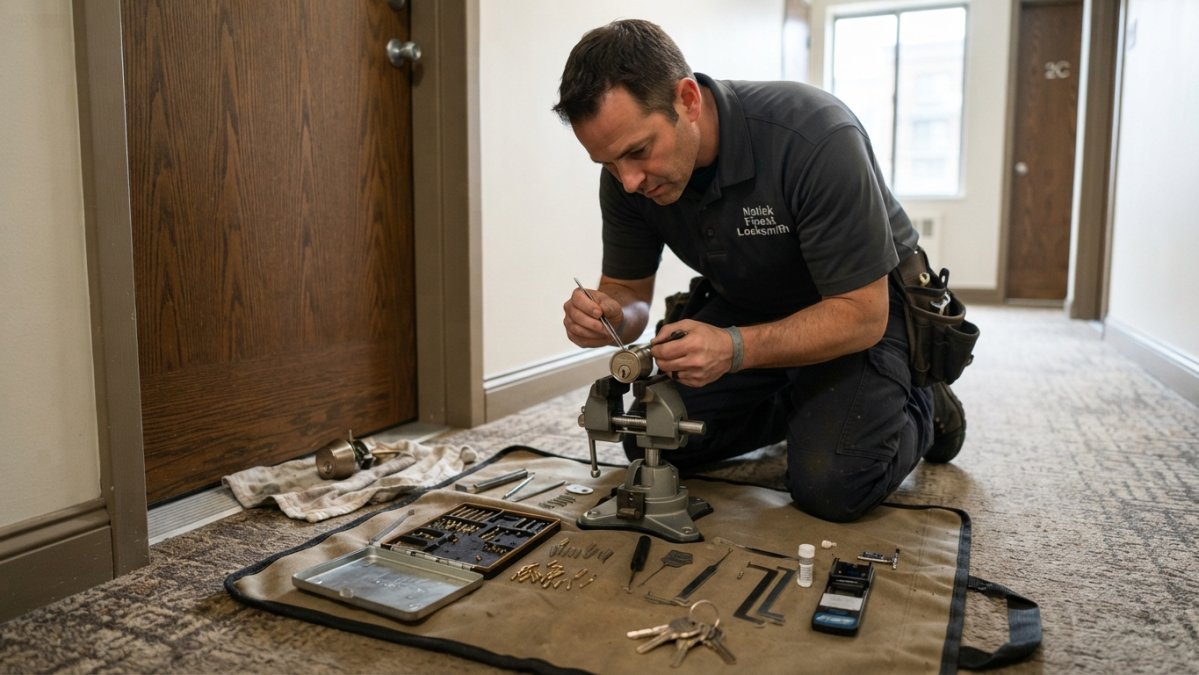
For deadbolt and knob lock combos, rekey both. A rekeyed deadbolt with an untouched knob lock leaves a working old key in the door.
Step 5: Track Completion Across the Portfolio
A batch is only done when every door in the group is logged as complete. Use a simple completion log with these columns:
| Unit | Door | Cylinder Group | New Key ID | Rekey Date | Old Key Tested | Copies Issued | Keys Returned |
|---|---|---|---|---|---|---|---|
| 1A | Front | A | K-101 | 10/12 | Yes | 2 | 0 |
| 1A | Back | A | K-101 | 10/12 | Yes | 2 | 0 |
| 1B | Front | B | K-102 | 10/12 | Yes | 2 | 0 |
If a row is blank, the door is not done. This is the record that lets you prove a rekey happened and that old keys no longer work.
Standardize hardware across properties whenever you replace a lock. If every unit uses the same brand and keyway, future rekeys collapse into a single group and take a fraction of the time.
If the job spans 15 units on a tight schedule, that is routine work for a professional, not a one-person weekend project.
Frequently Asked Questions
Are you allowed to change locks on a rental property?
In most U.S. jurisdictions, landlords are permitted to change or rekey locks on rental units they own, provided they follow state and local laws. Some states require giving tenants advance notice before entry, and a few cities mandate that landlords provide a key to the tenant after a lock change. Always check your state’s landlord-tenant statute and your lease agreement. For rekeying multiple rental property units, standardizing the process helps ensure compliance across your portfolio.
How do you organize keys when rekeying multiple rental units?
Use a tiered key control system. Assign each unit a unique key, then create a master key that opens all units for management use. Label keys with codes, not addresses, and store them in a locked cabinet with a sign-out log. For larger properties, consider a restricted keyway that prevents unauthorized duplication. This approach supports key control for property managers and simplifies handoffs during tenant turnover.
Can one key open multiple rental unit doors?
Yes, if you install a master key system. A master key opens all units in a building, while each tenant receives a change key that opens only their unit. This setup is common in apartment complexes and multi-unit properties. It lets maintenance staff access any unit without carrying dozens of keys, and it maintains security because tenants cannot open each other’s doors.
How long does it take to rekey several rental units?
A single lock rekey typically takes 15 to 30 minutes for an experienced locksmith. For a batch of units, a professional can often complete 10 to 15 units in a few hours, depending on lock type and accessibility. Scheduling all units in one visit reduces labor costs and downtime. If you are rekeying multiple rental property units, ask your locksmith about a portfolio rate and a coordinated schedule.
Managing keys across a dozen units is where most landlords get overwhelmed, and where security quietly slips. Natick Finest Locksmith takes that off your plate with same-day scheduling, experienced technicians, and code-compliant work backed by our Yankee Security Certificates. We offer convenient appointment times and cost-effective solutions built around your turnover calendar. Get started with Natick Finest Locksmith and keep every unit secure from move-in to move-out.